GUIDO DI BENEDETTO
E-MAIL UFFICIO:
PEC:
SOCIAL:
Impianti Tecnologici
Sede: Via M. Pira, 63
Selargius 09047 (CA)
P.IVA: 03977790926
guido.dibenedetto@gmail.com
Cell. 3292028888
Fire detection systems





Fire prevention
Quality and safety
Signaling devices
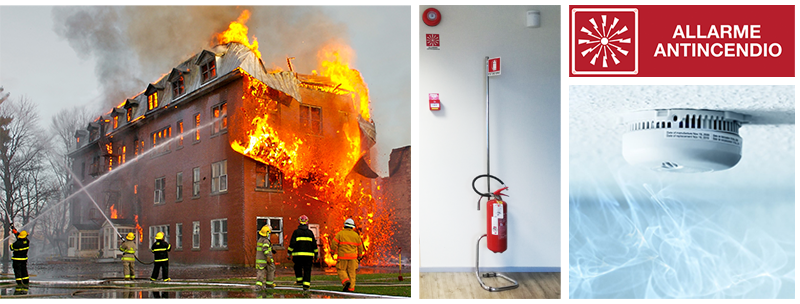
According to UNI standards, the fire-fighting system is the set of technical elements of the building system with the function of preventing, eliminating, limiting or signaling fires.
Implicit in the definition is the multiplicity of possible types for this plant, distinguishable in the following basic categories: signaling systems and fire extinguishing systems.
Fire-fighting systems may be required by law, in relation to the intended use and the dimensional and functional characteristics of the building. Fire detection takes place by means of sensors capable of signaling the presence of smoke or heat sources, while hydrants, lances, rotating belts and mobile fire extinguishers are prepared and adequately distributed for extinguishing. More rarely, a pressurized hydraulic network can be inserted, with automatic operation, governed by the fire detection system and equipped with diffusion nozzles (sprinkler network); in rooms where the use of liquids or foams would be harmful to the equipment present, automatic halon gas extinguishing systems are usually used; this is what happens, for example, in data processing centers.
The fire-fighting system, in the case of a residential building, is required when the building exceeds 24 meters in height. The plant is schematically constituted by:
galvanized iron water supply network;
fire mouths in containment box with built-in hydrant and related equipment (flexible fire hoses and water lances);
attack groups for fire brigade vehicles.
The water supply network, consisting of a system of generally underground pipes, supplies water to every part of the building to be protected by supplying the various fire-fighting utilities (hydrants, water supply systems, foam systems, etc.) .
A fixed automatic fire detection system (fire alarm) has the function of detecting, by means of special detectors, a principle of fire and signaling it in the shortest possible time. The fire alarm system may, and in some cases, must necessarily be integrated with components for the manual insertion of the equipment by humans. In both cases, the alarm signal will be transferred to the management / control unit and transmitted by it to the various signaling components (optical / acoustic panels, sirens, voice evacuation systems, etc.).

Telematic assistance and 24 hour availability
GUIDO DI BENEDETTO
E-MAIL UFFICIO:
PEC:
SOCIAL:
Impianti Tecnologici
Sede: Via M. Pira, 63
Selargius 09047 (CA)
guido.dibenedetto@gmail.com
Cell. 3292028888